Types of Printing Paper
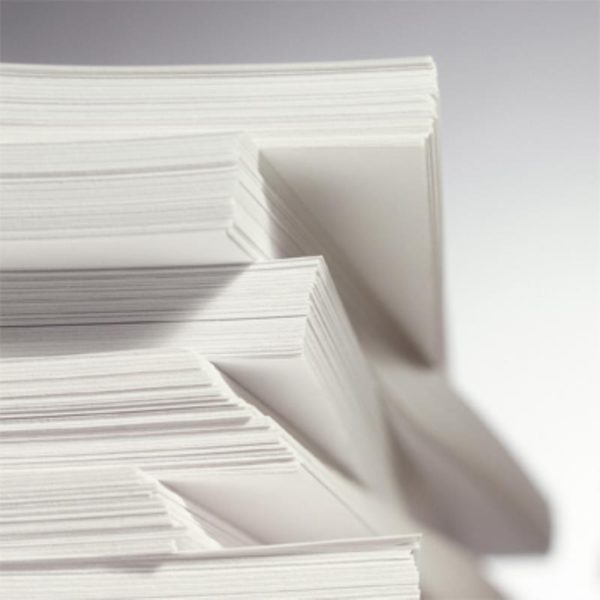
Although we live in a largely digital world, paper hasn’t gone away. And that’s a good thing—think about
the rush of opening a birthday card or that soft, satisfying feel of thumbing through a magazine.
Paper plays an important role in our everyday lives, and as a small business owner,
the paper you choose for your projects says a lot about who you are and what you offer.
Different products need different types of printing paper.
We’re here to ensure you’re always choosing the best paper for your needs.
Matte
Matte paper has a soft, non-glossy finish that slightly refracts light. Think of your standard printer paper—usually, it has a matte finish. Because a matte finish absorbs, rather than reflects, light, choose it to reduce or eliminate glare that can obscure a page’s content.
Glossy
Think of glossy paper as the opposite of matte. While matte paper absorbs light, glossy paper reflects it. This makes it ideal for photos and other colorful images, as it can make the colors brighter. Another good aspect about glossy paper is when folded it doesn't crack like matte paper does. Other good uses for glossy paper include menus and brochures.
Silk paper
Coating-wise, silk paper falls between glossy and matte. It’s shinier than matte but not as soft, and it’s softer than glossy but not as shiny. Generally, silk paper weighs 80 to 130 pounds. It strikes the ideal balance between these two ends of the glossy-matte spectrum. For any project that needs a high-end feel, silk paper is exactly what you need because of its smooth texture. Beyond flyers and posters, it’s a great choice for marketing materials such as postcards, business cards, rack cards and invitations.
Bond
Bond paper tends to be heavy-duty and durable, yet light—typically between 20 and 80 pounds. This makes it ideal for any document that needs to last a long time, like a report or an envelope. Bond paper is characterized by its lack of coating, which can leave it susceptible to scuffs and stains. That’s perfectly fine for products that aren’t distributed outside your office or otherwise don’t need to look pretty, but it is something to keep in mind when you’re considering bond paper for your print project.
Bond paper holds onto ink well, so it’s a great choice for any type of intricate logo or print. Aside from envelopes, it’s a good choice for company stationery.
Understanding key paper terms
Printing paper uses unique terms to describe the characteristics of different paper types. A few important paper terms to know include:
Weight
In paper, the term “weight” refers to the paper’s thickness. Sometimes it’s listed in pounds, such as “20 pounds” or “80 pounds.” Other times it’s listed as points, like “16 point.” These two conventions refer to how the paper’s thickness is measured.
With pounds, it refers to what an uncut ream of that paper type weighs. With points, it refers to how many thousandths of an inch thick a sheet of the paper is. For example, 16 point paper is 16/1000th of an inch thick. 10 point paper is 10/1000th of an inch thick.
Coating
Many types of paper—but not all—have a coating. This is the chemical outer layer applied to the paper that can change how much it shines, how much ink it absorbs, its texture and how colors appear.
The most common type of paper coating is aqueous coating. This type of coating has a bit of a shine to it, and it’s effective protection against fingerprints on the page. It’s generally recommended for heavier papers, as it can cause thinner paper to wrinkle.
UV coating is another type of coating, and it can be used to create a variety of finishes. It’s effective at protecting paper, but it can also make the paper difficult to fold, so it is not recommended for projects like pamphlets and brochures. For projects like these, go with propylene coating, which has a soft finish and can easily be folded.
Varnish coating is a low-cost, simple coating that offers less protection than other types, but is less expensive, which makes it a good choice for projects that don’t need to last a long time or won’t face a significant amount of handling.
Polyester coating is the most durable type of coating, which makes it perfect for any paper product that needs to stand up to regular handling and potential exposure to the elements. It tends to be fairly expensive, so it’s generally reserved for report covers, folders and other items that need to stand the test of time.
Finish
In discussions about the types of printing paper, “finish” is closely related to coating. While coating refers to the actual chemical coating on the paper, finish refers to the sensory experience it creates.
For example, matte finish produces softness. This means that it’s easier to fold and when you touch it with your fingertip, the paper might not feel perfectly smooth—instead, it could feel more like cloth than paper. Imagine a tissue or the paper in a sketchbook. In contrast, a glossy finish feels smooth to the touch, like you’re running your fingertip across a pane of glass or a piece of untextured plastic.